„Jumătatea goală a paharului gol” este o serie de articole în cadrul căreia rătăcim, împreună, prin partea întunecată a părții întunecate a existenței, urmând o rețetă standardizată în calea noastră către zenitul disperării – tratamentul este mereu alcătuit dintr-un citat (fie el dintr-o operă literară, un interviu sau un text de orice altă natură) și o recomandare muzicală, însoțită, după caz, de un extras din versurile acesteia.
Lasciate ogne speranza, voi ch’intrate!
Astăzi vă propunem: Jason Hickel – Less is More. How Degrowth Will Save the World și Flipper – „Life is Cheap” (de pe albumul Album Generic Flipper, 1982).
„Now consider a corporation, like Exxon or Facebook or Amazon. A corporation doesn’t operate according to the steady-state approach favoured by your local restaurant. Amazon’s profits don’t just go to putting food on the table for Jeff Bezos – they go into expanding the company: buying up competitors, putting local shops out of business, breaking into new countries, building more distribution centres, pumping out marketing campaigns to get people to buy stuff they don’t need, all to extract more profit each year than the year before.
It’s a self-reinforcing cycle – an ever-accelerating treadmill: money becomes profit becomes more money becomes more profit. And this is where we begin to see what makes capitalism distinctive. For capitalists, profit isn’t just money at the end of the day, to be used for satisfying some specific need – profit becomes capital. And the whole point of capital is that it must be reinvested to produce more capital. This process never ends – it just continues expanding. Unlike your local restaurant, which is focused on satisfying particular concrete needs, there is no identifiable end point to the process of accumulating exchange-value. It is fundamentally unhinged from any conception of human need.
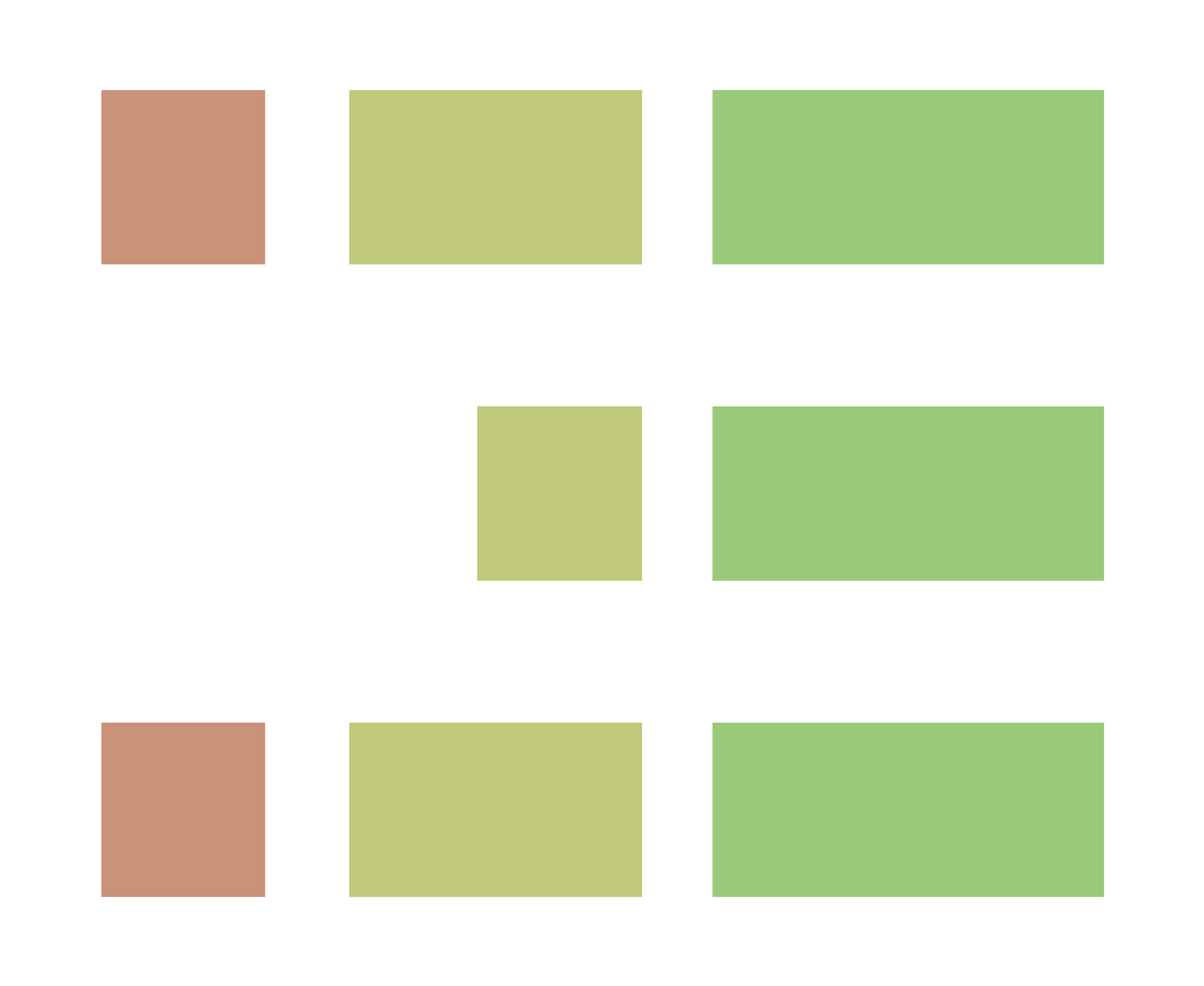
Looking at the formula above, it becomes clear that capital behaves a bit like a virus. A virus is a piece of genetic code that is programmed to replicate itself, but it cannot do so on its own: it has to infect a host cell and force that cell to create copies of its DNA, and then each of those copies goes on to infect other cells in order to create more copies, and so on. The sole purpose of a virus is self-replication. Capital too is built on a self-replicating code, and like a virus it seeks to turn everything it touches into a self-replicating replica of itself – more capital. The system becomes a juggernaut, an unstoppable machine that’s programmed for endless expansion.”[1]
„People cling to things to make their lives seem real
Crawling like bugs and some fool lingers healed
Boasting of freedom when they're tied down in chains
It's time you'd given up, here comes the death rain.

Life is pretty cheap, it's sold a decade at a time
Life is pretty cheap, it's so easy to find
Life is pretty cheap, there's really nothing new
Life is pretty cheap, except for the cause of the various few.”[2]
[1] Jason Hickel, Less is More. How Degrowth Will Save the World, Penguin Random House UK, Londra, 2022, pp. 86-87.
[2] Flipper, „Life is Cheap”, Spotify, https://open.spotify.com/track/6GTElD5YskDKTtlOS9oTLd?autoplay_ok=1, accesat în data de 21.08.2026.